trends
BCO report calls Cat A fit-out a major source of waste as London office build costs rise 42%
A British Council for Offices report written by Gardiner & Theobald and Turner & Townsend alinea says offices have become expensive by committee and urges developers to consider owner-delivered fit-out.
The British Council for Offices (BCO) has published a report concluding that offices are too expensive, after finding Central London build costs rose 42% between 2020 and 2025, twice the rate of tender price inflation.
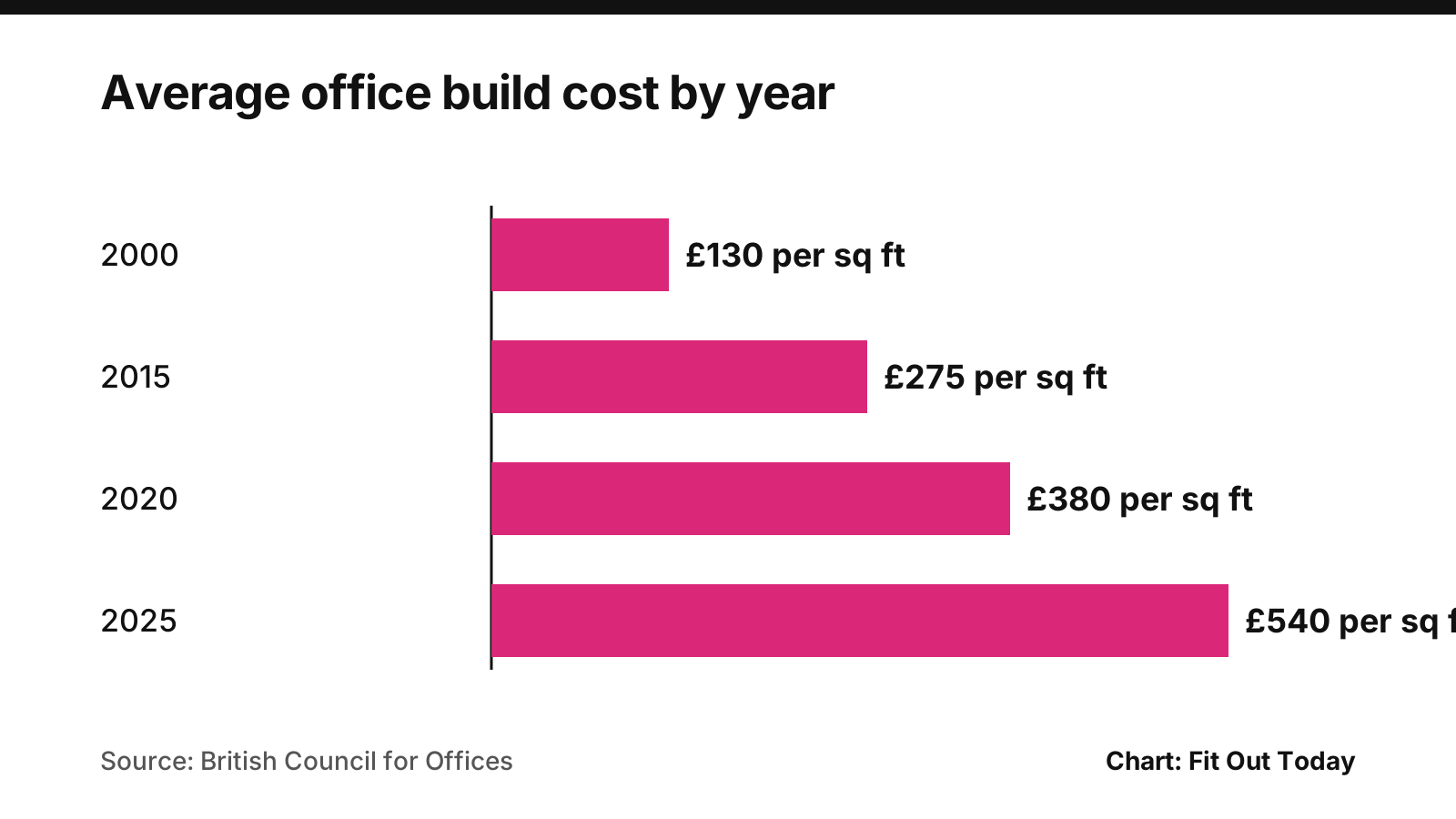
How to Deliver Viable Office Buildings in 2027, written by cost consultants Gardiner & Theobald and Turner & Townsend alinea, puts the average cost of building a Central London office at £540 per sq ft in 2025, up from £380 per sq ft in 2020. Tender prices rose 21% over the same period, the BCO said.
Of the £160 per sq ft increase, about £81 is explained by inflation. The authors link the remaining £79 to changing specification, planning, sustainability, regulatory and other project requirements.
Mark Lacey, director at Turner & Townsend alinea and co-author of the report, said: "The data shows that only around half of the rise in Central London build costs since 2020 can be explained by tender-price inflation. The rest, roughly £79 per sq ft, comes from specification, planning and regulatory requirements."
Fit-out and Cat A waste
For the fit-out sector, the report's most direct finding is its description of Cat A fit-out as one of the industry's biggest sources of waste. Newly installed finishes and services are routinely stripped out by occupiers shortly after completion, the BCO said.
Among its recommendations, the report suggests considering owner-delivered fit-out where demand is clear, to cut waste and shorten occupation programmes.
Tenants also face high costs. Citing Turner & Townsend's Global Office Fit-out Cost Guide 2026, the report ranks London the second most expensive city in the world for fit-out, narrowly behind New York, with typical costs of £260 to £430 per sq ft.
Turner & Townsend's own release on that guide, published on 14 May 2026, covered 58 cities and said New York had regained the top spot. It put London's high-specification fit-out costs at $5,872 per m2, despite a 1% fall.
Where the money has gone
The authors describe offices as having become expensive by committee: each new requirement is defensible on its own, but no single party chooses the total specification or owns its aggregate cost.
Drawing on practitioner experience, the report estimates that planning-led design, shape and form, including fifth elevations, terraces, public areas and facade greening, adds up to about 6% to cost on affected schemes. Fire safety, building regulations and building control add about 3%, and amenity and hospitality-led provision about 2-3%.
Multiple accreditations, certifications and assurance requirements add a further 2-3%, and embodied-carbon requirements about 1-4%, though not always a premium. The report cautions that these categories overlap and should not be added together, and says increasingly complex building services act as a multiplier across all of them.
Costs and rents over 25 years
The BCO said costs have outrun rents for 25 years. Between 2000 and 2015 office build costs rose 112%, from £130 to £275 per sq ft, while average City prime headline rents rose 16%, from £50 to £58 per sq ft.
Rents have since risen 72% to £100 per sq ft by 2025, but build costs rose a further 96% over the same decade.
| Year | Office build cost (£ per sq ft) |
|---|---|
| 2000 | 130 |
| 2015 | 275 |
| 2020 | 380 |
| 2025 | 540 |
The report says the strongest schemes in the strongest locations can support the rent required, but this does not translate into broad-based deliverability where rents are lower or existing buildings and sites add constraints.
Not a call for cheap buildings
The BCO said the answer is not indiscriminate de-specification. Instead, every element should earn its place, with the case tested early enough to shape the design.
Recommendations include challenging the brief early by testing occupational density, small power, structural loading, ESG certifications, amenity space and cycle provision against what occupiers need; deciding early which parts of existing buildings to retain on re-use schemes; and involving the supply chain early with clearly defined roles and fair allocation of risk in procurement.
The report also asks the industry to treat the BCO's own Guide to Specification as a framework rather than a checklist. The BCO describes the guide as its flagship best practice guide; the current edition it lists is the 2019 Guide to Specification.
BCO chief executive Samantha McClary said: "This is not a call to build 'cheap' buildings. Great offices matter more than ever, and occupiers are telling us that quality is what they want. But every element needs to earn its place."
Gavin Murgatroyd, partner at Gardiner & Theobald and co-author, said the industry needs to focus on what the occupier really wants rather than what suits the industry in silos.
Background
The report follows Turner & Townsend alinea's November 2025 London market report, which described the capital's commercial market as subdued and said viability was the most pressing issue on most projects. That report also pointed to labour shortages and wage increases as a significant driver of construction price inflation.
In December 2025 the BCO published Viability and Sustainability in the Regions, which found the UK's most sustainable office space is concentrated in London and the Big Six cities and said this threatens the long-term resilience of regional office markets elsewhere.
The BCO, founded in 1990, describes itself as a membership organisation devoted to research and discussion, with more than 4,000 members. The new report is available for members to download.
On the record: Gardiner & Theobald, Turner & Townsend
Sources
- British Council for Offices (opens in a new tab) (accessed 2026-11-09)
- British Council for Offices (opens in a new tab) (accessed 2026-11-09)
- British Council for Offices (opens in a new tab) (accessed 2026-11-09)
- British Council for Offices (opens in a new tab) (accessed 2026-11-09)
- Turner & Townsend (opens in a new tab) (accessed 2026-11-09)
- Turner & Townsend alinea (opens in a new tab) (accessed 2026-11-09)
This story was researched from the primary sources above and checked against them before publication. Spotted an error? Tell us and we will correct it promptly.