trends
BCO becomes 200th Circularity in Practice signatory with Cat A fit-out waste in its sights
The British Council for Offices has partnered with the King-inspired Circularity in Practice initiative, pledging to bring its 4,000 members behind materials reuse after its own research named Cat A fit-out a leading source of waste.
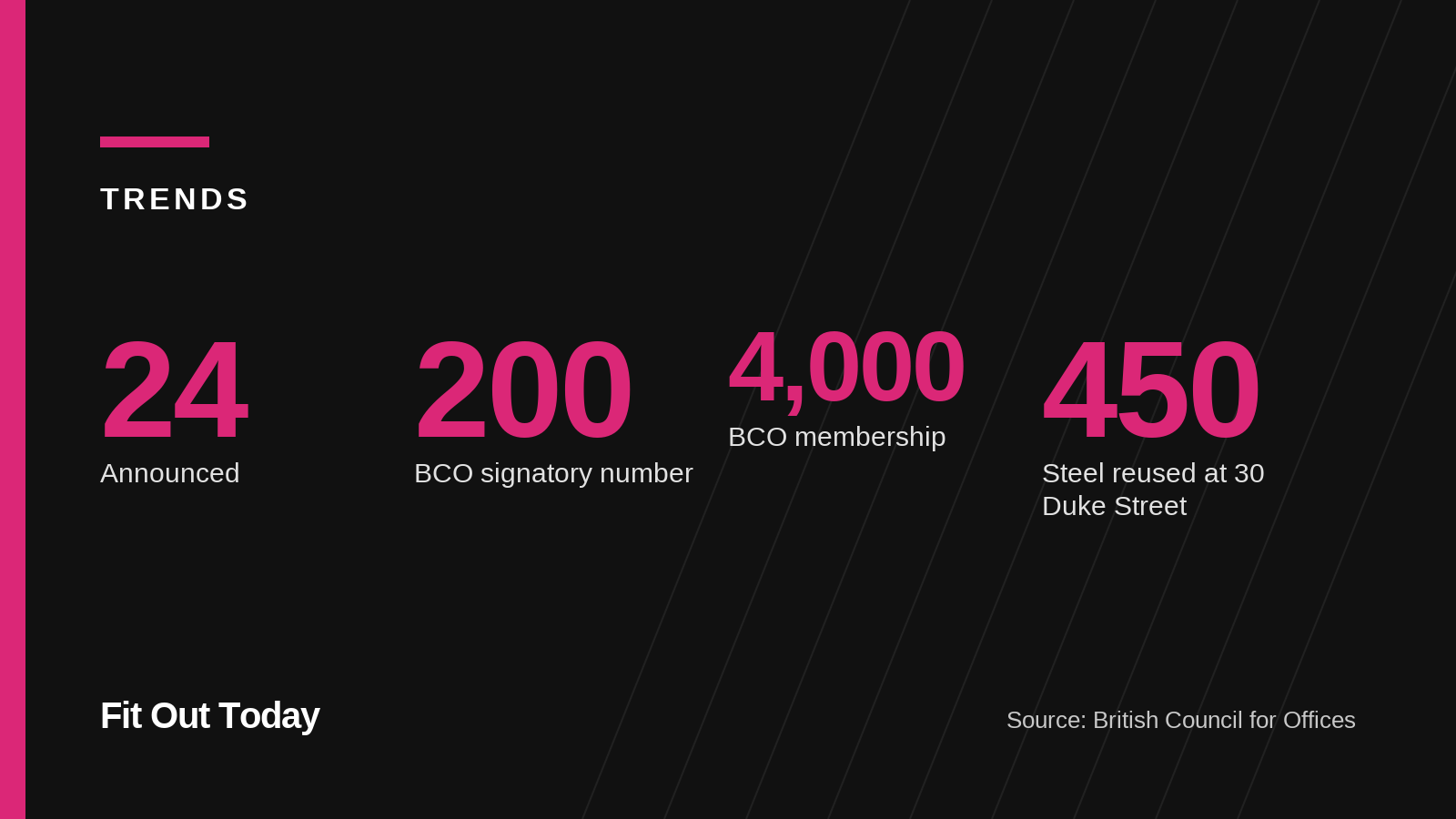
The British Council for Offices (BCO) has become the 200th signatory to Circularity in Practice, the national reuse initiative inspired by the King, in a partnership announced on 24 November 2026 that targets waste from Cat A fit-out.
The BCO said the tie-up would bring its 4,000-strong membership of developers, investors, occupiers, designers, contractors and building managers behind practical action to design, develop and operate circular workspaces.
The body said its recent research on viable office buildings had identified Cat A fit-out as one of the industry's biggest sources of waste. Its publications list carries a report titled 'How to deliver viable office buildings in 2027', dated 9 November 2026.
Samantha McClary, BCO chief executive, pointed to GPE's 30 Duke Street in St James's as the model. "The challenge for our industry now is not proving that circularity works, but scaling it, so that buildings like 30 Duke Street become the norm rather than the outlier," she said.
What the BCO has committed to
As a signatory, the BCO said it would apply circular principles to its own events, publications and operations, and report progress within 12 months.
It will encourage developers, investors, occupiers and their supply chains to sign the pledge, and run a programme of talks and tours of circular projects, from deconstruction audits to reused steel frames, led by the teams that delivered them.
The partnership will also convene members on the issues the BCO said stall reuse: warranties, insurance, supplier certainty, pre-demolition audits, material passports and bringing specialists in at concept stage. Circularity in Practice case studies will appear in BCO content, and the BCO noted that circularity is already recognised through its ESG Awards.
The programme of events includes a session at next year's BCO Conference in Paris.
Michelle Pinggera, whom the BCO describes as chair of Circularity in Practice, said the BCO's membership and nationwide reach would help the initiative connect with more regions and encourage more organisations to sign the pledge. GPE described Circularity in Practice as a nationwide, voluntary initiative run as a business-led, cross-sector taskforce.
The 30 Duke Street exemplar
Helen Hare, director of projects at GPE and immediate past president of the BCO, said GPE reused 450 tonnes of structural steel at 30 Duke Street and returned more than 400 tonnes to the market, as well as putting Portland stone from the original facade and marble from the original building back into the new one.
"This partnership provides a practical way to do that, and I would encourage every BCO member to sign up," she said.
GPE's own releases add detail to the scheme. In its September 2026 completion announcement, the developer said 78% of the building's steel frame came from recovered steel, primarily from its deconstructed City Place House, cutting the carbon associated with the frame by around 90% compared with using entirely new steel.
Its July 2026 materials-reuse release recorded 21 tonnes of Portland stone from the original French Railways House repurposed on site, and marble from the original staircase reused in the new reception. GPE said it has set challenging goals across its development programme for materials reuse.
Designed by Make Architects, 30 Duke Street was fully pre-let before completion. GPE said Clayton, Dubilier & Rice (CD&R) took the entire 62,300 sq ft of office space in May 2025, more than a year ahead of completion, with the retail units let to M.J. Bale and L'Eto. The developer said average rents came in 6.7% ahead of estimated rental value, supporting an anticipated development profit on cost of 37.1%.
McClary said the building showed circularity "can deliver design quality, a stronger connection to place and commercial returns at the same time".
The BCO, founded in 1990, is due to report on its own circularity progress within 12 months of signing.
Sources
- British Council for Offices (opens in a new tab) (accessed 2026-11-24)
- GPE (Great Portland Estates) (opens in a new tab) (accessed 2026-11-24)
- GPE (Great Portland Estates) (opens in a new tab) (accessed 2026-11-24)
- GPE (Great Portland Estates) (opens in a new tab) (accessed 2026-11-24)
- British Council for Offices (opens in a new tab) (accessed 2026-11-24)
This story was researched from the primary sources above and checked against them before publication. Spotted an error? Tell us and we will correct it promptly.