products
Fewer than four in 10 UK consumers confident judging paint's green credentials, BCF survey finds
Ipsos research for the British Coatings Federation found 39% of UK adults would feel confident assessing a paint's environmental impact, prompting the trade body to urge buyers to look beyond 'eco' labels.

The British Coatings Federation (BCF) has urged UK paint buyers to look beyond 'eco' and 'natural' labels after an Ipsos survey it commissioned found only 39% of adults felt confident judging a paint's environmental impact.
The survey of 1,130 UK adults aged 16 to 75 found 46% were not very or not at all confident in weighing up a product's green credentials. Of the 39% who were confident, 7% said they were very confident and 32% fairly confident.
The BCF, which said it represents manufacturers responsible for about 95% of decorative paint sold in the UK, wants consumers to take an evidence-based approach rather than rely on how a brand describes itself.
Zoe Slade, Sustainability Manager at the British Coatings Federation, said: "There is no official UK definition of an 'eco' paint, so consumers shouldn't assume that a product is better for the environment simply because it carries the term 'eco' or 'natural' on the label."
What drives paint choice
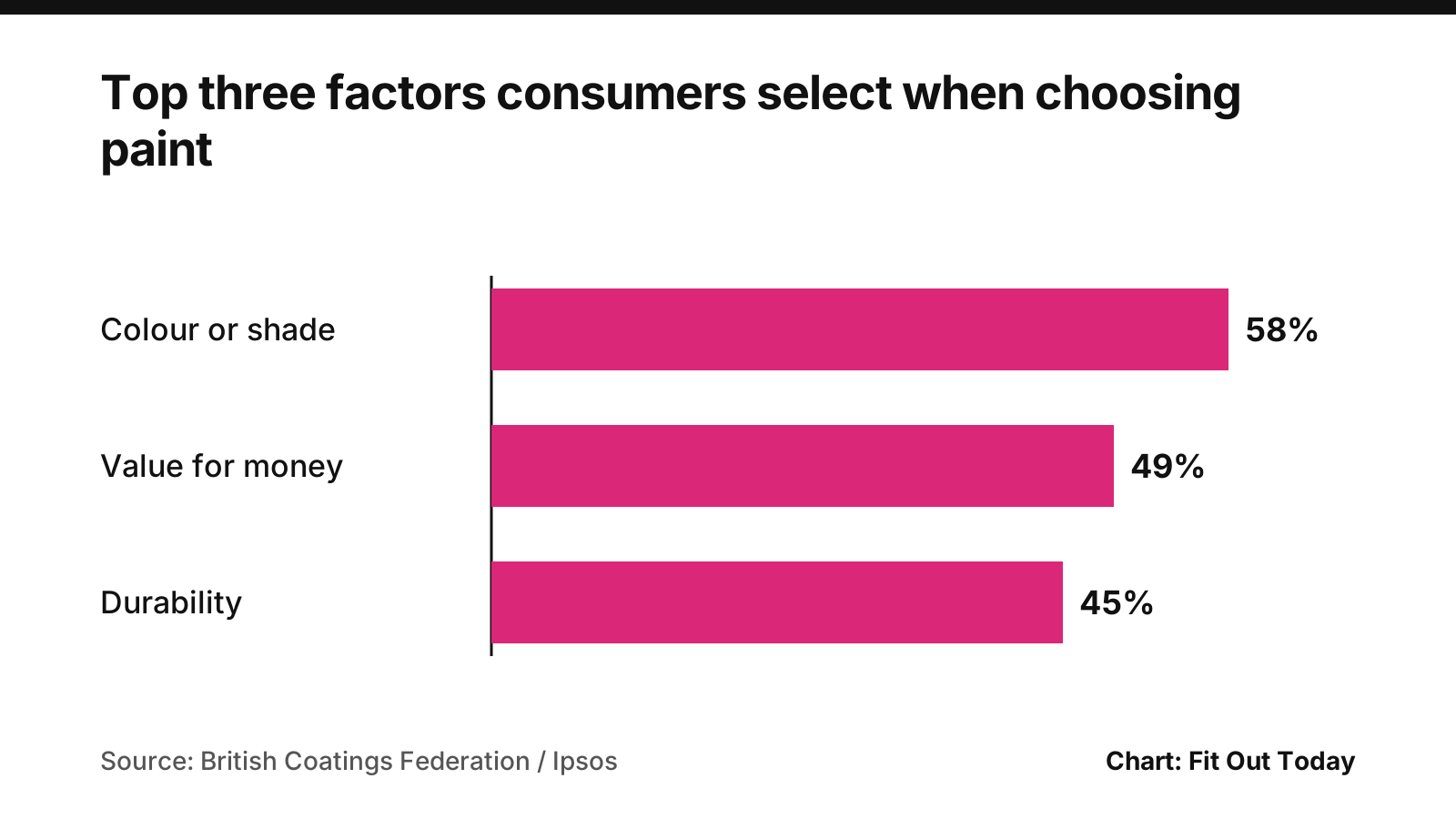
Asked to pick their top three factors from 10 options when buying paint for home decoration, respondents most often chose colour or shade, value for money and durability.
| Factor | Share selecting it in top three |
|---|---|
| Colour or shade | 58% |
| Value for money | 49% |
| Durability | 45% |
Environmental performance ranked higher among younger buyers. Some 18% of 16 to 24-year-olds put being environmentally friendly in their top three, more than twice the 8% recorded among those aged 25 and over.
Social media also carries more weight with that age group. One in 10 adults overall said they would trust social media content for information on a paint's environmental credentials, rising to 27% of 16 to 24-year-olds.
"There is a huge amount of information available online, particularly on social media, but not all of it is based on sound science," Slade said.
The BCF warned that some organisations making green claims on social media have links to particular paint products or brands, and said buyers should consider the evidence behind any claim.
Asked which single factor has the biggest effect on a paint's environmental credentials, 20% of respondents pointed to water-based rather than solvent-based formulas, 18% to the level of volatile organic compounds (VOCs) and 15% to endorsement by environmental organisations.
Slade said environmental impact should be considered across a product's lifecycle, from raw materials and manufacturing through to performance, durability and disposal.
Leftover paint and packaging
The research also asked how people would deal with leftover paint. Some 43% said they would be most likely to keep it at home. Among the 641 respondents who would not, 69% would choose a recycling route, with 48% opting for a council Household Waste Recycling Centre and 21% for a DIY store scheme where both were available. One in five would throw leftover paint away and 7% did not know.
For empty paint packaging, 47% of all respondents would be likely to choose a recycling option, against 42% who would put it in household waste or store it at home.
The BCF's PaintCare initiative aims to lift the re-use or re-manufacture rate for leftover paint from 2% today to 75% by 2032. PaintCare says much leftover paint is separated out and disposed of as hazardous waste at considerable cost to local authorities. Its website puts the volume of waste decorative paint generated in the UK each year at an estimated 55 million litres.
The guide and the regulatory backdrop
The BCF said it recently published its De-Mystifying Eco Paints Guide, covering VOCs, water-based versus solvent-based paint, durability, the raw materials used in manufacture and the correct disposal of unwanted paint.
Slade said the guide was not about telling consumers which paint brands or products to buy, but about giving them the facts they need to understand the environmental claims they see and make their own decisions.
According to the BCF, most modern decorative paints sold in the UK are water-based, low in VOCs and subject to UK safety and environmental regulation. Many manufacturers display the federation's Globe Icon on labels to show VOC levels.
Environmental marketing claims already fall under consumer protection law. The Competition and Markets Authority published its Green Claims Code on 20 September 2021 to help businesses meet their existing obligations when making such claims.
The research was carried on the website of the Painting and Decorating Association, which describes itself as a non-profit and the only UK-wide trade body dedicated to the painting and decorating sector. Formed in July 2002 through a merger involving the British Decorators Association, its members range from sole traders to large national contractors.
Ipsos surveyed 1,130 UK adults aged 16 to 75 for the study.
Sources
- Painting and Decorating Association (opens in a new tab) (accessed 2026-10-30)
- PaintCare (British Coatings Federation) (opens in a new tab) (accessed 2026-10-30)
- Painting and Decorating Association (opens in a new tab) (accessed 2026-10-30)
- Competition and Markets Authority via GOV.UK (opens in a new tab) (accessed 2026-10-30)
This story was researched from the primary sources above and checked against them before publication. Spotted an error? Tell us and we will correct it promptly.